Wednesday, May 6, 2015
Chaco - Soy Field
Chaco - Soy Field.
Double-Plate Etching, Chine-Collé.
15cm x 15cm. 2015.
I had signed up to make a small portfolio exchange print and since most of my work this semester revolved around cattle ranching, I decided to explore the direction of soy plantations a bit since, which is growing rapidly in the Chaco. I turned the forest upside down and juxtaposed the finely drawn, individual trees and cacti with the uniform and repetitive soy plants. Unlike much of the cattle ranching which (at least partially) benefits local ranchers, it appears most of the soy plantations are in the possession of foreign investors, which use the land and funnel the profits out. However, I need to do more research on this issue before I can make broad claims.
Chaco Ranch I & II
Chaco Ranch I.
Etching, Chine-Collé.
30cm x 30cm. 2015.
Chaco Ranch II.
Etching, Chine-Collé.
30cm x 30cm. 2015.
Tuesday, May 5, 2015
Chaco
One of the first exercises I gave myself during my second semester was to make a small copper plate that I could alter through various editing processes. Since one of my key topics is the disappearance of the dry forest, I started with a drawing, or rather etching, of a typical Chaco forest (Chaco I).
Chaco I.
Etching, Aquatint, Chine-Collé.
30cm x 30cm. 2015.
For the second stage I rigorously scraped the plate to re-create the changes in the landscape on my plate with the forest slowly disappearing. Despite my rigorous scraping, the image still looked rather neat (see center left part of Chaco II). I've always wanted to try an open bite on a plate and here was my chance, hoping the open bit would attack the plate more rigorously than my scraping did. I stopped out the middle part of the plate so it wouldn't be affected by the acid. For the open bite, I simply put the plate in the acid without any aquatint on it, so the acid just etched away the surface. I left the plate in for about an hour. The result was quite different from what I expected. a) it was much cleaner than I had anticipated, and b) I hadn't cleaned my lines very well it seems, so the ink or grease residue worked as a resist in the acid while it bit all around the lines. The lines were quite raised in the end, almost like a high relief collagraph and I ended up scraping them down a bit. Another interesting thing happened: the plate showed a vertical linear dripping pattern on the surface of the plate. I etched the plate in a vertical tank and apparently the trickling down of tiny copper particles during the etching process somehow worked as a resist and resulted in an uneven surface etch.
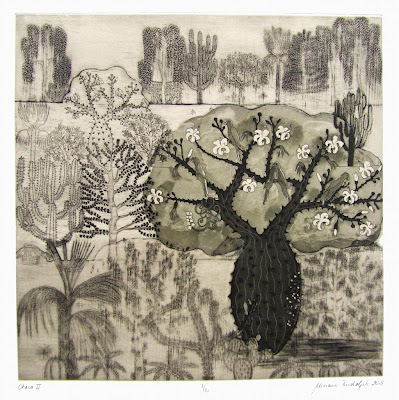
Chaco II.
Etching, Aquatint, Open Bite, Chine Collé.
30cm x 30cm. 2015.
For the third stage I drew a grid over the whole image. I did a stage-bite aquatint to recreate the land surveillance process and to imitate the aerial views/satellite images of the area after the forest has been cut for ranching. I don't think the third plate is quite resolved yet. It's a bit too blocky I find. Maybe I'll tackle it again in the future to fine-tune it a bit more, or I may just leave it as an exercise. I do like the interplay between the layers of the plate, between what was before and what is now.

Chaco III.
Etching, Aquatint, Chine-Collé.
30cm x 30cm. 2015.
Chaco I.
Etching, Aquatint, Chine-Collé.
30cm x 30cm. 2015.
For the second stage I rigorously scraped the plate to re-create the changes in the landscape on my plate with the forest slowly disappearing. Despite my rigorous scraping, the image still looked rather neat (see center left part of Chaco II). I've always wanted to try an open bite on a plate and here was my chance, hoping the open bit would attack the plate more rigorously than my scraping did. I stopped out the middle part of the plate so it wouldn't be affected by the acid. For the open bite, I simply put the plate in the acid without any aquatint on it, so the acid just etched away the surface. I left the plate in for about an hour. The result was quite different from what I expected. a) it was much cleaner than I had anticipated, and b) I hadn't cleaned my lines very well it seems, so the ink or grease residue worked as a resist in the acid while it bit all around the lines. The lines were quite raised in the end, almost like a high relief collagraph and I ended up scraping them down a bit. Another interesting thing happened: the plate showed a vertical linear dripping pattern on the surface of the plate. I etched the plate in a vertical tank and apparently the trickling down of tiny copper particles during the etching process somehow worked as a resist and resulted in an uneven surface etch.
Chaco II.
Etching, Aquatint, Open Bite, Chine Collé.
30cm x 30cm. 2015.
For the third stage I drew a grid over the whole image. I did a stage-bite aquatint to recreate the land surveillance process and to imitate the aerial views/satellite images of the area after the forest has been cut for ranching. I don't think the third plate is quite resolved yet. It's a bit too blocky I find. Maybe I'll tackle it again in the future to fine-tune it a bit more, or I may just leave it as an exercise. I do like the interplay between the layers of the plate, between what was before and what is now.
Chaco III.
Etching, Aquatint, Chine-Collé.
30cm x 30cm. 2015.
Changing Landscapes: Visual Explorations of Growth, Expansion and Destruction
Well, it is time I introduce my new work from this past semester. It is a tricky and very complex topic I'm trying to tackle while at the same time exploring new ways to make and compose my imagery. The topic I have chosen for my possible thesis topic is about the changing landscapes in the Paraguayan Chaco, my former home as most of you probably know. The region with its dry forests is changing rapidly due to an economic boom in beef production and also an expansion of soy plantations. Over the past few years I've repeatedly come across articles in reputable newspapers such as the New York Times and The Guardian which focus on the rampant deforestation happening in and around my home community. It's a topic that I've been wanting to address in some way or other for a while, and I believe grad school might be right place to try out some more political work away from the pressures of gallery markets (as much as I love those settings as a working artist and which I hope to return to again eventually). I am greatly concerned with the environmental impact the economic boom in the Chaco has on the region, but at the same time I also see the improved life styles of many of the people in the Mennonite community where I grew up. I'm not entirely sure yet where all of my investigations will take me and my work, but I'm hoping to create some dialogue about issues of deforestation and economic growth, sustainable farming, and possibly land rights for the indigenous communities who are also affected by the economic boom. I am currently in Paraguay to conduct some research and I'll try to write an entry towards the end of the month with some reflections. (I apologize for the long break in posting and now the sudden deluge, but my second semester of my MFA was so stressful I didn't manage to keep up with my blog. I hope that'll be different again in the future now that I'm finished with all my coursework. The remainder of my time at the University of Alberta I will mainly dedicate to making art).
Sunday, March 29, 2015
Ink Oxidation
Detail of print - Searching.
Edmonton is known for being extremely dry in winter. (Before we finally invested in a humidifier, the humidity in our apartment was down to 10%). Along with the dryness came an unforeseen problem with one of my prints (Searching). A few days after printing part of the edition, I noticed that my ink looked more brown than black; also, most of the lines lost their crisp form and looked like they were bleeding a bit (see short vertical lines). Instead of putting the prints between flattening boards right away, I let them air-dry to keep the thick and raised lines intact without squishing them down. Now I know that black ink, when it's quite thick on the paper and dries too fast, can oxidize and turn a dark rusty brown colour with a kind of iridescence. My initial response was dismay: a whole day's work lost! However, there are solutions to the problem. To take care of the oxidation, simply spray a thin layer of a drawing fixative spray, more like a mist, across the surface of the print and the oxidation disappears instantly and permanently. To prevent it from happening in the first place, I've seen people put a sheet of glassine over the freshly printed prints in the drying rack, which prevents the ink from drying too fast. Lesson learned.
Tuesday, March 10, 2015
Falling
Falling
Double-Plate Etching, Chine-Collé.
60cm x 30cm. 2015.
I just finished the fifth and last piece in my grieving series (for now). That does not mean I'm done grieving, but I want to move in a different direction with my work at the university. In fact, I already have changed gears and I've been working on this piece a little bit on the side, but I've refrained from posting any of my other work so far to retain some kind of continuity in this blog.
Falling is based on one of my first ink sketches from last semester that I thought had some potential to be worked into a print. It is based on a dream (more like a nightmare) about falling into a dark hole I've had and it deals with the feeling of loosing ground after the loss of my father. It deviates from my usual square format in this series; I doubled the square to give more of a sense of falling. Again I worked with photo-etching for the figure, for which I screen printed a halftone image with straight acrylic paint onto the copper plate as a resist template. The ink washes I replicated with soap ground and the grey patterning is line work with a little bit of aquatint on a second plate that I print on top of the black.
That's it for now. I'll post some of my experimental pieces soon that might thematically lead to my thesis work in the future.
Friday, February 20, 2015
Renewed Canada House in London Opens
Manitoba Room
Canada House, London
Yesterday was the royal opening of the revitalized Canada House on Trafalgar Square in London. After reading an article in the Winnipeg Free Press about a beautiful handmade oak table by J. Neufeld in the Manitoba Room and seeing a list of artists (I among them!) that are part of the Manitoba Room (see last paragraph in the article), I searched for images to see if my prints might be in any of the photographs from the opening. I was lucky and found one photo with My Winnipeg IV in it on the official Canada House website. There is an article about the art and design in the building as well as additional photos of other artworks if you want to take a look.
Many thanks again to L.A. Pai Gallery in Ottawa for submitting my work!
Subscribe to:
Posts (Atom)

